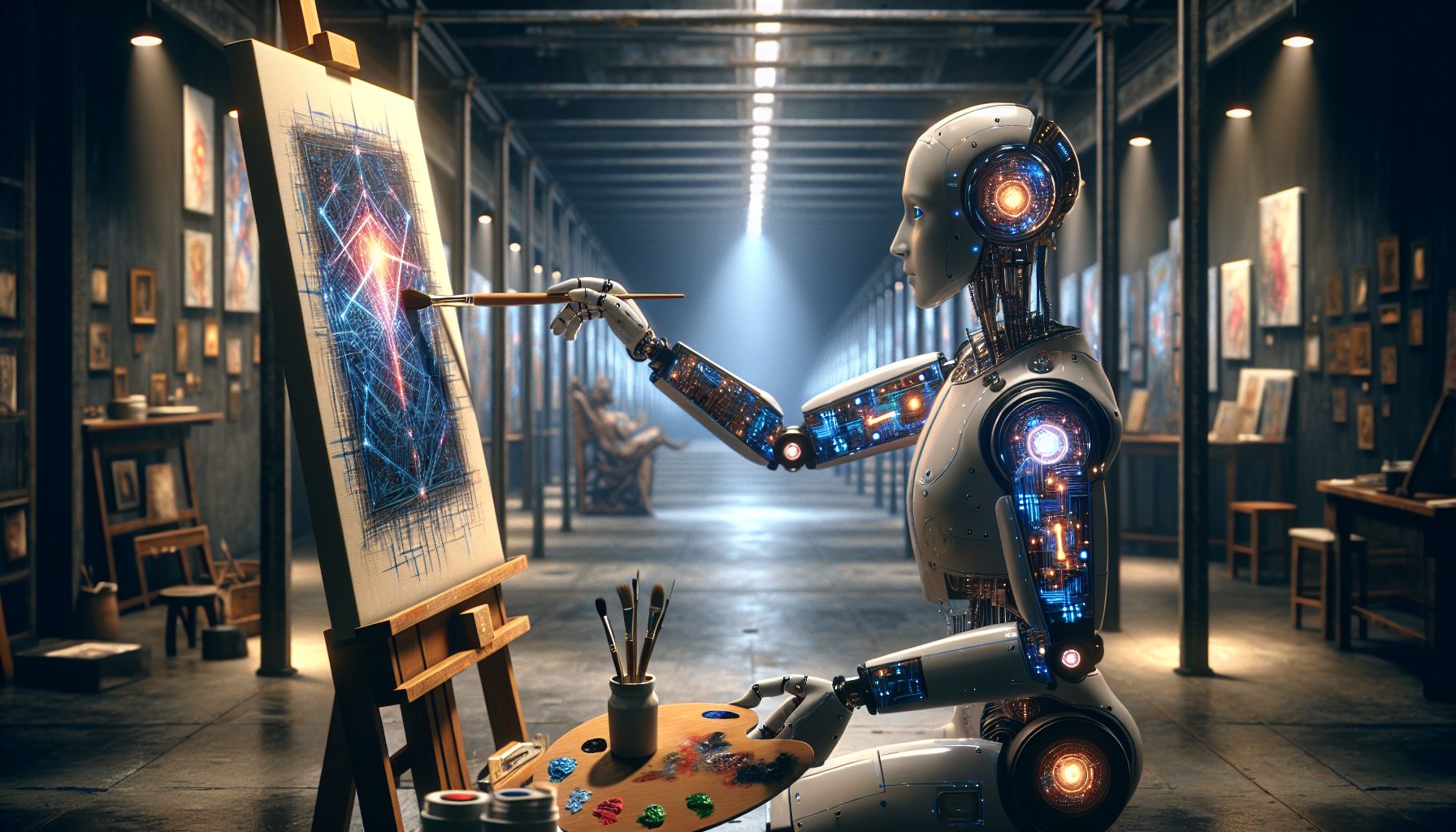
Hey there tech explorers! If the idea of AI as the new Renaissance arouses either a skeptical brow raise or a gleeful fist pump, you’re in the right place. We’ve all heard stories of AI mastering complex strategies, like obliterating grandmasters in chess and Go. But now, it’s breaking into the realm of creativity, our sacred territory, adding its own brushstroke to canvases, melodies, and even the written word. Today, we’re looking at how AI isn’t just a useful assistant but a muse in the creative arts. Grab a cup of coffee, and let’s explore how our silicon-based buddies are redefining what it means to be creative.
The New Digital Paintbrush
Artificial Intelligence is showing off with digital artistry that’s more than just code-generated doodles. Programs like OpenAI’s DALL-E and Google’s DeepDream have changed how we think about and create art. DALL-E produces images from text descriptions in ways that often leave the AI’s human counterparts awe-struck, and perhaps a bit nervous.
AI art generators use complex algorithms and neural networks to analyze existing artworks, then create something completely new. Imagine telling a machine to paint you “a fluffy koala in a Van Gogh style,” and voilà, a masterpiece appears! This isn’t just Picasso meets Skynet. This is history meeting the future on a digital canvas at warp speed.
Yet, while some marvel at AI’s abilities, others question its authenticity. Is a piece of art created by an algorithm truly art, or just sophisticated mimicry? I think about this philosophical puzzle often and love that maybe, and perhaps ironically, the answer is whatever makes us feel most human.
The AI Symphony
From algorithmic compositions to AI-driven performances, music is another frontier where artists are finding a new creative partner. Tools like Sony’s Flow Machines and Google’s Magenta are pushing boundaries by crafting compositions that literally strike a chord with listeners.
For example, Sony’s AI composed a Beatles-esque rock tune back in 2016 called “Daddy’s Car.” And let me tell you, the first time you hear an AI-made song that could rock a festival stage, it’s a mix of awe and a touch of existential crisis. “Is this our new musician overlord?”
AI-generated music isn’t just about creating compositions, it’s about collaborating. Brian Eno, the legendary composer, once mentioned in his Oblique Strategies, “Use an old idea.” Ironically, AI does just that. It mashes up old ideas to make something that’s both new and nostalgically familiar. Musicians are discovering that AI can be their creative partner, offering suggestions and variations they might not have dreamed up alone.
AI in Storytelling: Plotting the Future
Storytelling has always been a deeply human act, yet AI has found its narrative voice. Natural Language Processing (NLP) combined with Generative Pre-trained Transformer (GPT) models, like OpenAI’s GPT-3, are powerful text generators that string together plots or dialogue coherent enough to rival any sleep-deprived novelist.
These technologies can do everything from drafting short stories to writing ad copy that’s more compelling than a late-night infomercial. The entire process is kind of like having an editor who never gets tired, never asks for a coffee break, and doesn’t binge-watch TV when it should be editing your manuscript.
Some argue these AI authors may lack the soul or gut understanding of the human condition that ink-and-paper scribes bring. Others, however, see AI as a toolkit for unlocking potential narratives, helping writers out of creative slumps or inspiring new approaches to their craft. Imagine Terry Pratchett and a sentient laptop working out a literary masterpiece together. Pure magic, right?
Challenges and Ethical Dilemmas
Even as we embrace this new era, there are important questions we need to wrestle with. One major concern is originality and copyright. When an AI “creates,” who owns that work? Is it the developers of the AI, the person who inputs the prompt, or the AI itself? It’s a bit of a legal mess, kind of like deciding which cat owns the couch. You can argue all day, but at the end of the day, it’s still covered in cat fur.
Moreover, there’s the constantly ticking ethical clock. What happens when machines start mirroring biases present in their training data? AI can either be a neutral tool or an amplifier of prejudices, depending on how we shape it. As we code the future of creativity, we need to do so with empathy and inclusivity in mind.
What’s Next? Speculating On The Future
With the creative possibilities nearly endless, I find myself dreaming (sometimes with a cocktail in hand) about the next phase of AI artistry. In the future, could we see AI directors co-creating films with auteurs, or AI choreographing dances unseen by human improvisation? Just imagine a Broadway play where an AI-generated composer works alongside Andrew Lloyd Webber, debuting a musical that feels both classical and cutting-edge.
The balance between technology and creativity is a delicate dance. But when handled well, AI in creative arts promises to be an energetic collaboration that enriches our cultural world. And that’s the beauty of it, who knows what will come next? In this digital renaissance, the canvas is wide open, and every keystroke or algorithmic flourish is just the beginning of an amazing story.
So, here’s to the trailblazers braving this bold new age, where art and technology walk hand in hand into a future that’s as exciting as it is unpredictable. Cheers to creativity, now and forever.