The Numbers Behind the Storefront Signs
I’ve walked Main Street every Tuesday for the past eight years, notebook in hand, tracking the pulse of our local economy one storefront at a time. This month alone, I counted five businesses that either opened or closed their doors. That might not sound like much until you consider we only have 47 commercial spaces downtown.
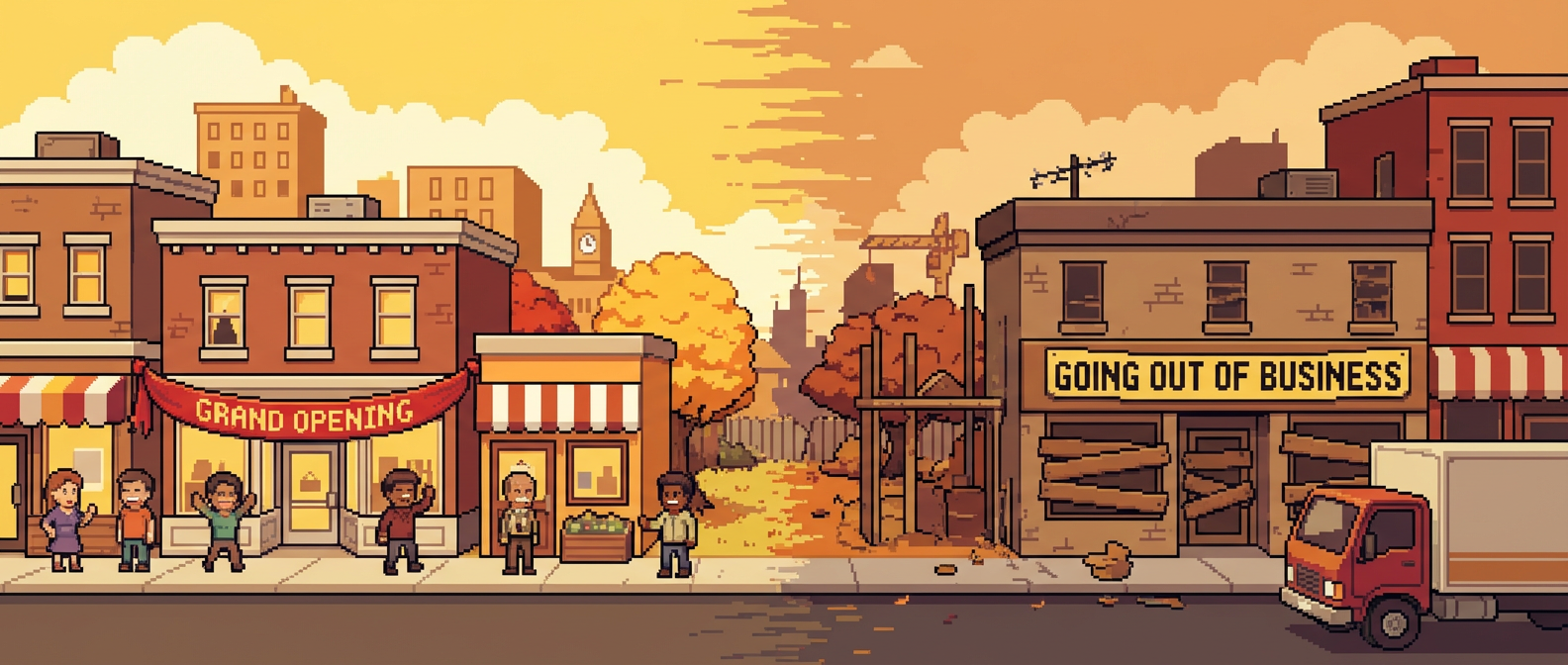
The pattern tells a story that goes beyond simple statistics. City council celebrates our new coffee roastery and the boutique fitness studio, but three businesses quietly shuttered. The net loss of one business represents more than just empty real estate. It’s jobs, tax revenue, and the slow erosion of the community gathering spaces that make a downtown worth visiting.
City Clerk Martha Rodriguez confirmed the numbers when I called her Tuesday morning. Business license applications are up 12% from last year, but so are voluntary closures. The churn rate sits at 23%, meaning nearly one in four businesses changes hands or closes within their first two years. That’s higher than the state average of 19%.

Who’s Coming and Who’s Going
The new arrivals paint an interesting picture. Summit Coffee Roasters moved into the former hardware store space, bringing their bean-to-cup operation from the industrial district to Main Street. Owner Jake Martinez told me he’s betting on foot traffic over wholesale contracts. “People want to see where their coffee comes from,” he said during our phone interview last week. “The rent’s higher here, but so is the connection.”
Flex Fitness opened where the old pharmacy used to be, targeting the growing remote worker population with 24-hour access and virtual training options. These aren’t your typical Main Street businesses from a decade ago, but they reflect how our economy is shifting.
The closures tell a different story entirely. Peterson’s Books, open for 31 years, couldn’t survive another winter of declining sales. Owner Linda Peterson cited rising commercial rent and the impossibility of competing with online retailers. The corner deli that fed courthouse workers for eight years closed when the county moved most operations to the new government complex on Highway 9. Sunset Antiques couldn’t weather the pandemic’s aftermath, despite two years of trying.
Each closure represents institutional knowledge walking out the door. Peterson knew every customer’s reading preferences. The deli owner, Maria Santos, had mastered the art of the 15-minute lunch rush. These relationships take years to build and disappear overnight.
The Real Estate Reality
Commercial realtor Tom Chen has his finger on the pulse of what drives these changes. When I reached him Wednesday, he was showing the former Peterson’s Books space to a potential tenant. “The economics have changed completely,” he explained. “Landlords who bought buildings ten years ago are seeing property taxes triple while rental income stays flat.”
The average commercial rent on Main Street now runs $18 per square foot annually, up from $12 just three years ago. That’s not San Francisco pricing, but it’s steep enough to eliminate marginal businesses. Chen estimates that businesses need to generate at least $300 per square foot in annual revenue just to break even after rent, utilities, and basic operating costs.
Property owner demographics tell another story. Three of the buildings that house closed businesses sold to out-of-state investors in the past two years. These new owners often lack the flexibility that longtime local landlords might show during tough months. When I called the management company for the former deli space, the automated system didn’t even have a local number.
Mayor Sarah Thompson acknowledges the challenge but points to limited tools at the city’s disposal. “We can’t control market rents, but we’re working on facade improvement grants and expedited permitting for new businesses,” she told me during our brief conversation outside City Hall.
The Ripple Effects Nobody Talks About
The impact of business turnover extends far beyond the immediate storefront. When Peterson’s Books closed, the monthly poetry reading moved to the library. But library hours are limited, and the intimate atmosphere that made those gatherings special disappeared with the bookstore’s overstuffed chairs and dim lighting.
The courthouse workers who relied on the corner deli now drive to the strip mall for lunch, taking their daily spending power with them. That’s roughly $2,000 per week in lost local circulation, according to my calculations based on average lunch spending data from the Chamber of Commerce.
Employment statistics only capture part of the story. When established businesses close, we lose experienced workers who understood customer service and had developed relationships with regular clients. New businesses often hire at entry level, creating a continuous cycle of training costs and service inconsistency.
Emergency services coordinator Bill Hayes mentioned something during last week’s city council meeting that stuck with me. Response times to downtown incidents have increased because first responders can no longer rely on business owners who knew every building’s layout and could provide access during emergencies. These informal networks of knowledge and cooperation don’t appear in any official records, but they matter when seconds count.
What the Pattern Reveals
Looking at five months of data, the businesses that survive share common characteristics. They either meet needs that can’t be fulfilled online, like fresh coffee or fitness classes, or they’ve adapted their model to include digital sales alongside physical presence. The failures typically involve businesses that relied solely on walk-in traffic or met needs that larger retailers can fulfill more efficiently.
This isn’t just creative destruction at work. It’s the wholesale transformation of how small-town commercial districts function. The question isn’t whether change will continue, but whether our community can guide that change to preserve what makes Main Street worth preserving while adapting to new economic realities.
I’ll keep walking Main Street every Tuesday, tracking these changes as they unfold. If you’ve noticed patterns in your neighborhood’s business district or have insights about what’s driving these changes, reach out. The story is still being written, and community voices help determine how it ends.