Most of us start the day exactly the same way. We grab the phone, squint at the screen, and open an app—Apple News, Google News, Flipboard, SmartNews, maybe some social feed that’s quietly turned into a news portal—and we let somebody else’s algorithm decide what matters. We tell ourselves we’re staying informed. Truth is, we’re walking into a casino where the house always wins, and the chips on the table are our attention spans.
News aggregators have quietly become the main gatekeepers of public knowledge. They are not neutral pipes. They’re businesses built on engagement metrics, and those metrics have almost nothing to do with whether a story actually matters. They measure holds, taps, scrolls, dwell time, shares. They reward content that pokes an emotional reflex, not content that helps a citizen make a sound decision. This isn’t some accidental glitch. It’s the design.
The Architecture of the Engagement Trap
To see the problem clearly, you have to look at what’s humming inside the machine. When you open an aggregator, a recommendation system sifts through millions of stories and picks the handful it will show you. That choice is not built on journalistic value. It’s a prediction: Which of these items is most likely to make you click, react, or linger?
These models are trained on oceans of behavioral data. They learn that outrage beats nuance. Fear smothers context. A cheap celebrity feud reliably gathers more taps than a dry but urgent report on municipal water policy. The algorithm doesn’t have a bucket labeled “important.” It has buckets marked “high-performing” and “low-performing.” Over time, the whole system tilts the news experience toward the emotional, the divisive, the superficial.

This isn’t a side effect of digital distribution. It’s the core business logic. Aggregators sell attention to advertisers, or they peddle subscriptions that depend on habitual use. Either way, the metric that counts is time-on-platform. A story that helps you understand a messy issue but leaves you calm and thoughtful is, by the cold math of engagement, a failure. It gave you something real and asked nothing back. The platform cannot monetize that.
Why “Giving People What They Want” Is a Dangerous Lie
A common defense from the tech side goes like this: aggregators just reflect user preference. The algorithm shows you what you want. If people wanted hard news, the argument runs, hard news would surface. Sounds democratic. It’s actually a cynical dodge.
Human attention is not a clean signal of rational interest. It’s warped by cognitive biases that evolution baked into us long before newspapers existed. We’re wired to notice threats, novelty, and social conflict. A headline about a plane crash anywhere in the world will hijack your focus faster than a headline about a slow-rolling change in local zoning laws—even if that zoning change will shape your rent, your commute, and your children’s school. The algorithm exploits that wiring. It doesn’t correct for it.
Worse, the feedback loop feeds itself. As the aggregator serves more emotional, low-context content, it trains the audience to expect that kind of stimulus. Attention spans splinter. Tolerance for complexity drops. Publishers, watching their referral traffic, start to produce more of what the aggregator rewards. The news ecosystem reshapes itself to feed the machine. Over a decade, we’ve watched entire newsrooms pivot toward click-driven journalism—not because editors lost their principles, but because the economics of distribution gave them no escape hatch.

The False Promise of Personalization
Plenty of aggregators sell personalization as the fix. Tell us what you like, they say, and we’ll build you a better feed. This misses the point entirely. The problem isn’t that the feed shows you stuff you dislike. The problem is that the feed is tuned for a metric that has zero relationship to democratic health.
Personalization often makes things worse. It builds a tight bubble where every story confirms a worldview or massages a known interest. You stop running into the uncomfortable, the unfamiliar, the slow-burn story that asks for patience. The aggregator turns into a mirror. A well-functioning news diet should feel a little abrasive. It should include stories you didn’t know you needed. Engagement-optimized personalization sands away that friction, and with it, the chance of genuine learning.
What Gets Crowded Out
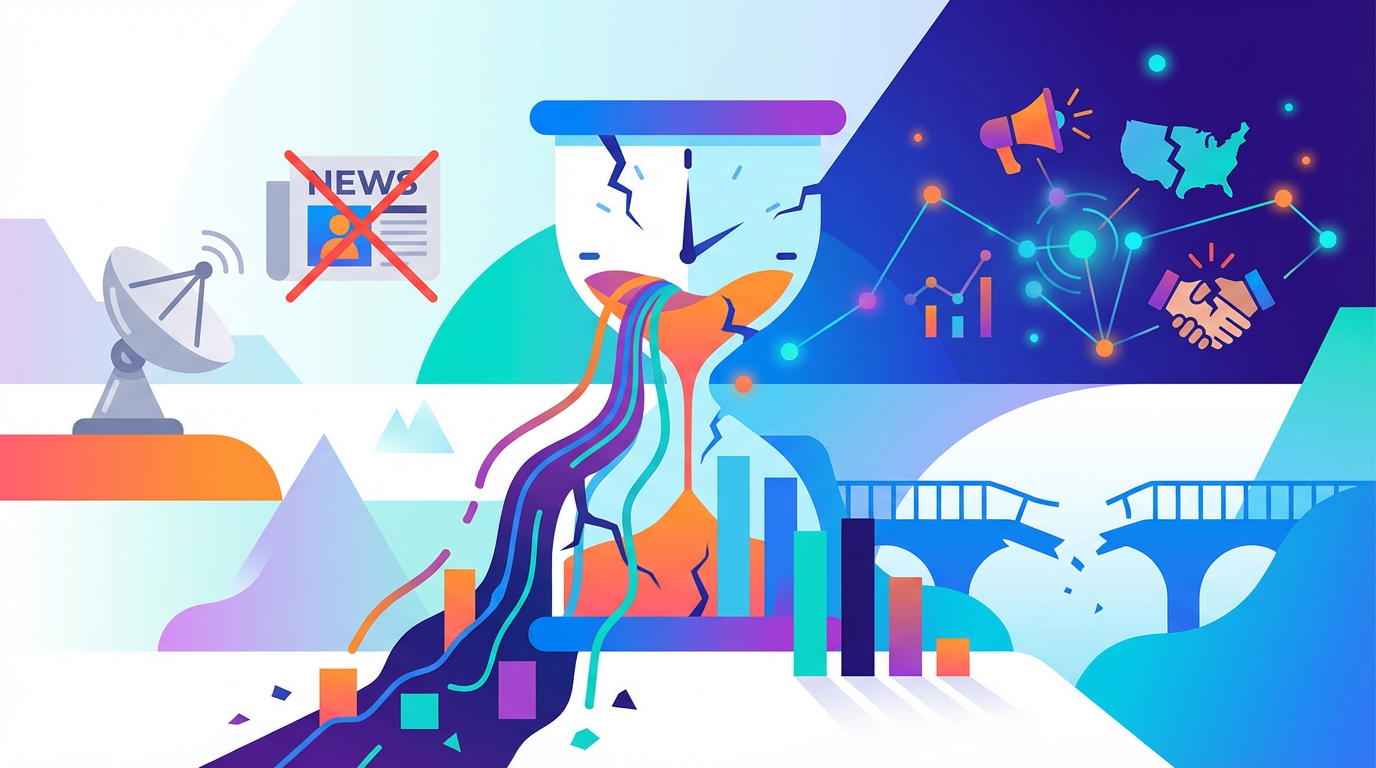
The most damaging effect of engagement-first aggregation is not what pops up in your feed. It’s what vanishes. For every story that goes viral, there are dozens of consequential reports that never break through the algorithmic floor.
Consider the types of journalism that lose every single time:
- Infrastructure and governance reporting. Stories about bridge inspections, water quality data, school board budgets. This is the connective tissue of civic life. It does not trend.
- Scientific and medical research with uncertain conclusions. An algorithm hates uncertainty. It wants resolution, preferably with a villain or a miracle. A study that says “the evidence is mixed” is engagement poison.
- International coverage without a domestic hook. A coup in a small nation, a famine developing over months, a diplomatic breakthrough that took years—these rarely clear the bar unless there’s a dramatic visual or a celebrity angle.
- Accountability journalism that took six months to report. The investigation that demanded dozens of FOIA requests, deep document review, and careful legal vetting cannot compete on speed. By the time it publishes, the algorithm has already moved on.
The aggregator creates a structural disadvantage for exactly the kind of reporting that democracies need most. It’s not censorship in the old-fashioned sense. Nobody is stopping these stories from being published. But they are rendered invisible by a distribution system that treats them as noise.

The Velocity Trap
Speed is another distorting force. Aggregators reward recency and novelty with heavy boosts. The story that just broke, the take that just posted, the tweet that just went up—these get priority placement. This creates an environment where being first is more valuable than being right. Corrections, when they finally arrive, travel a fraction of the distance that the original error covered. The aggregator has no built-in mechanism to slow down, to wait for verification, to say “this story is developing, let’s hold until we know more.” The architecture demands constant motion.
Media Literacy as a Survival Skill
None of this is an argument for throwing away technology. Aggregators are tools, and tools can be used with open eyes. But using them well demands a shift in mindset that most of us were never taught. Media literacy, in the age of engagement algorithms, isn’t about spotting fake news. It’s about understanding the economic incentives that shape every headline you see.
Here are the questions you should be asking every time you crack open a news aggregator:
- Why is this story in my feed? Did an editor make a judgment about its importance, or did a machine predict I would click on it?
- What emotion is this headline trying to provoke? If the answer is anger, fear, or smugness, the story is likely engineered for engagement, not understanding.
- What is missing? What stories about my city, my region, my world are not breaking through because they lack an emotional hook?
- Who benefits if I share this? Not just the publisher, but the platform itself. Every share is free distribution that keeps another user inside the ecosystem.
These are not comfortable questions. They force you to treat your own attention as a contested resource—which it is. The aggregator wants you to scroll on instinct. Resisting that takes effort, every single time.
Building a Healthier Information Diet
There is no perfect tool, but there are better habits. The goal is to shift from a passive, algorithm-fed experience to an active, intentional one.
Start by diversifying your entry points. If you lean entirely on an aggregator, you are handing all judgment to a black box. Add direct sources to your routine: a local newspaper’s website, a nonprofit newsroom, a subject-specific newsletter written by an actual human. These outlets still carry their own biases and business pressures, but at least you can identify them. You cannot interrogate a recommendation algorithm. You can interrogate a masthead.
Pay for something. This isn’t a moral lecture; it’s a structural one. When you subscribe to a news organization, you change its incentives. A subscriber-supported newsroom can afford to publish the bridge inspection story that will never trend. It can invest in the six-month investigation. It can resist the gravitational pull of the aggregator because its revenue doesn’t depend entirely on clicks. Free news is not free. You pay with your attention, and the aggregator pockets the toll.
Practice deliberate delay. The aggregator wants you to react right now. Train yourself to wait. If a story triggers a strong emotional response, step back. Read the same event covered by three different outlets. Hunt down the original source. Check the date. The most manipulative content depends on impulsive sharing. Time is its enemy.
Finally, get comfortable with boredom. A news feed that ranks importance above engagement will sometimes feel slow. It will include stories you have to work to understand. It will lack the cheap dopamine hits of outrage and gossip. That’s not a bug. It’s the whole point.
Frequently Asked Questions
Are all news aggregators equally bad for engagement-driven curation?
No, but the differences are narrower than they look. Some aggregators, like Apple News, mix human editorial curation with algorithmic recommendations. Others, like Google News, lean harder on machine learning. But even human-curated sections often sit inside an app that measures every tap and tailors future feeds accordingly. The business model still depends on time spent in the app. The core tension between importance and engagement doesn’t vanish just because a human touched the top stories queue.
Can’t I just train the algorithm by telling it what I want?
You can nudge it, but you can’t escape the underlying logic. Liking, saving, or following topics tells the system to serve more of that topic. It does not tell the system to rank significance above emotional pull. An algorithm trained on clicks will still rank stories within your chosen topics based on engagement potential. If you follow “climate change,” you might get more extreme weather videos and fewer policy analyses. The signal you send is about subject matter, not journalistic quality or civic value.
What should I do if I can’t afford multiple news subscriptions?
Start with your local library. Many library systems offer free digital access to major newspapers and magazines through services like PressReader or OverDrive. You can also use a few carefully chosen free sources—public broadcasters, nonprofit newsrooms, and specialized newsletters—and pair them with an intentional habit of checking original reporting rather than platform feeds. The key isn’t spending more money; it’s spending more attention on sources that are accountable to readers rather than to engagement metrics.
How do I know if a story is important or just engaging?
Apply a simple test: ask yourself what you would lose if you never saw the story. If the answer is “I would miss something entertaining but my understanding of the world would not change,” the story is probably engagement bait. If the answer is “I would be less equipped to vote, to understand my community, or to make a decision that affects my life,” the story has genuine weight. This test is subjective, but it forces a distinction that the aggregator will never make for you.
The news aggregator isn’t going anywhere. But you don’t have to use it on its terms. The machine will keep optimizing for engagement. You can choose to optimize for something else.